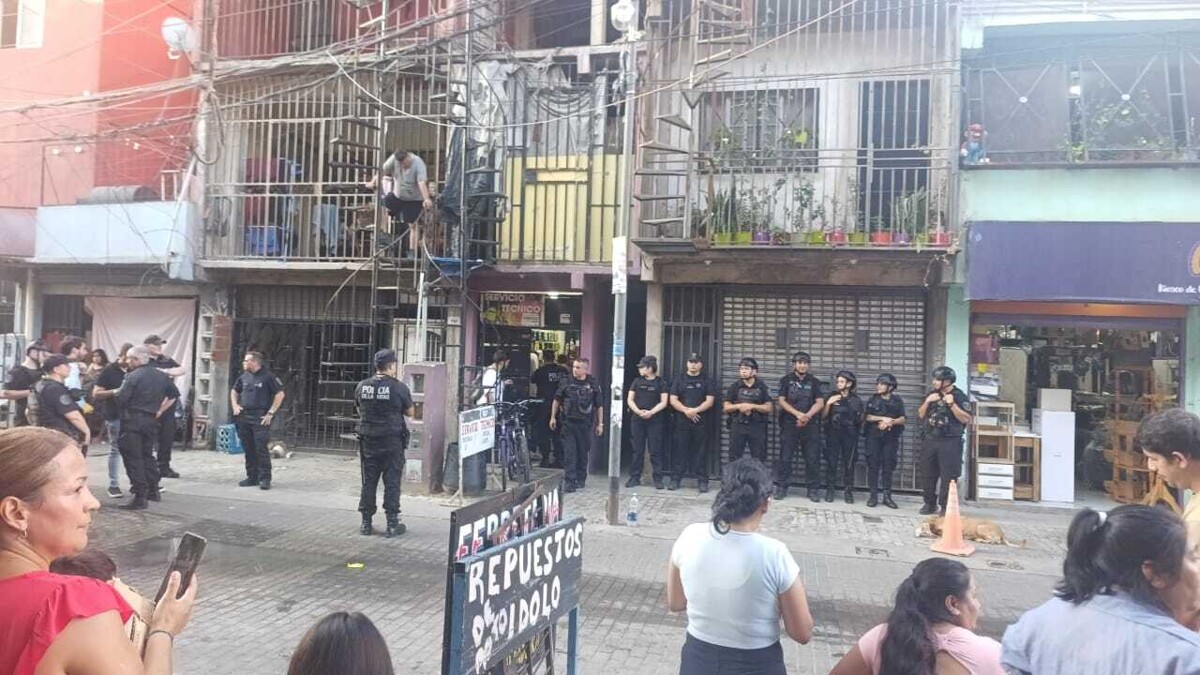
Today, walking through the neighborhood means encountering constant police raids, low shutters out of fear of closures, and the incessant noise of quads marking territory on every corner. It is a direct attack on the popular economy under the pretext of urban planning. “They make life more complicated than it already is for the neighbors of the neighborhood,” says the young communicator, who warns that the city government is not achieving urban integration because “dialogue, consensus is needed, something that does not seem to be happening.” Streaming as a collective response In the face of harassment, the proposal is to turn on the camera. “In the neighborhood, everyone is on high alert, because at any moment the police can arrive with their motorcycles, cars, or trucks loaded with chainsaws; literally, because they destroy everything and take away the merchandise they find, even if you prove that everything is in order,” describes Villalba. For the chronicler, this “lockdown effect” is a trap: “It is estimated that there are more than 60,000 inhabitants in the neighborhood.” After the raid suffered by filmmaker Alan Gómez while filming in Barrio Padre Mugica, a collective of young journalists decided that the best response is visibility. The initiative is supported by the experience of journalism and streaming workshops that Mundo Villa organizes at the Casa de la Cultura, seeking to make technology accessible to everyone. For Alan Gómez, streaming is the natural evolution of a territorial work that today acquires political urgency: “It is a tool that bothers. Today, the same state that gave them awards and mentions sends police operations to interrupt the work for which they were recognized. What is the supposed illegality? After the police harassment of filmmaker Alan Gómez while filming, community media and social organizations from Villa 31 are calling for a live stream this Tuesday. However, the analysis from Mundo Villa's journalism warns of a direct tune with the measures of the Buenos Aires City Government: “There is a line that all the city's evils come from those who live in the villa, and with that excuse they seek to eradicate us.” There is a striking contradiction: years ago, this production company was declared of General Interest by the Buenos Aires Legislature. For her part, Villalba concludes with a bet on organization: “We don't know if we are going to find an immediate solution, but we want to spread what is happening by sharing the anguish, but also with humor, because we believe that the way out is always collective.” The appointment for this exercise in popular communication will be tomorrow, Tuesday, April 7, at 2:00 p.m. “We were working with our cameras, doing shots, and suddenly quads with officers appeared,” recalls the producer. In this scenario, the right to circulate or to earn a living became a gray area where the officer decides who passes and who does not. Filming is not a crime, but documenting the realities of neighborhoods bothers the power. This audiovisual project began in 2019 in Villa 21-24, Barracas, founded by Alan Gomez and seven friends who created an enterprise that breaks prejudices in the audiovisual world, generating content that reflects the identity and culture of popular neighborhoods from their own perspective. “We do this program on the street so that neighbors can approach and tell what is happening to them, so that these cases are not forgotten. It is not just a radio program; it is a tool for informational self-defense in a climate of saturation and closures that suffocates the neighborhood.” The uniform as a border: between “order” and exclusion While the Head of Government of the City, Jorge Macri, announces measures of “integration and order,” in the hallways, patrol cars circulate with chainsaws to further tighten the economic crisis in popular sectors. “This proposal arises from the urgency of meeting and thinking of solutions,” reflects Dalma on the Tuesday's event. Members of the “Berretines Audiovisuales” production company were approached by the City Police while working in the Territory. From the heart of Villa 31, the transmission will seek not only to denounce institutional violence but also to strengthen a network of media that refuses to be silenced in its own territory. This Tuesday at 14:00, a joint broadcast between Mundo Villa, Mundo Sur FM, and Berretines Audiovisual will take the equipment to the street to carry out an open stream. “Being on the street is our thermometer of society.” The communicators are not exempt from this logic: a few days ago, a police operation intercepted Alan Gómez, filmmaker and director of Berretines, while filming a documentary that tells the stories of the villas. That is the question that the Buenos Aires officials have not been able to answer coherently. Awarded in the Legislature, persecuted in the street For Gómez, the detention for “carrying a face” is already part of a violent normality. They denounce a “lockdown effect” that criminalizes culture and suffocates the popular economy under the pretext of urban planning. Despite the tension, the team did not show resistance to an unjustified act. Closing access complicates daily life: from the gas bottle distributor to the entry of an ambulance for emergencies.” The “Eva” project is the most recent and ambitious work of the production company, as it represents a key step in its evolution from music videos and short films to larger-scale productions, maintaining its popular essence in the audiovisual narrative. A besieged popular economy This pressure and constant fear is what journalist Mundo Villa and Communication graduate Dalma Villalba analyzes.